LASIK and PRK are often discussed together because both can correct refractive errors by reshaping the cornea, but the procedures are not performed in the same way. People comparing refractive surgery in Cary, North Carolina can explore both LASIK and PRK with our team at Laser Eye Center of Carolina. Board-certified and fellowship-trained Dr. Dean Dornic has experience with LASIK, PRK, LASEK, SBK, and intraocular lens procedures, which allows treatment discussions to consider more than one refractive technique.
LASIK and PRK Correct Many of the Same Vision Problems
Both procedures change the shape of the cornea so light can focus more accurately on the retina. Depending on your prescription and eye health, they may be considered for refractive errors such as nearsightedness, farsightedness, and astigmatism.
The biggest distinction is not necessarily what they correct. It is how the surgeon reaches the corneal tissue being reshaped.
In simple terms:
- LASIK involves a corneal flap. A thin flap is created and lifted so the underlying tissue can be reshaped. The flap is then returned to position.
- PRK does not create a flap. The outermost layer of the cornea, called the epithelium, is removed before the underlying corneal tissue is treated.
- Early recovery differs. Because the surface layer needs time to regenerate after PRK, visual recovery is generally slower than after LASIK.
Those differences can matter when deciding which procedure makes more sense for a particular eye.
Why PRK May Be Recommended Instead of LASIK
LASIK is well suited to many patients, but creating a corneal flap is not advisable for everyone. For example, PRK may be discussed when corneal measurements show that a flap-based procedure is not the better choice.
Corneal thickness, eye dryness, prescription, and other findings can all influence the recommendation. That does not make PRK a lesser version of LASIK. It is a different surgical approach that may be preferable for certain patients.
Our practice provides several vision correction procedures, so the conversation does not have to begin with the assumption that everyone seeking refractive surgery should have the same treatment.
Your Measurements Help Guide the Choice
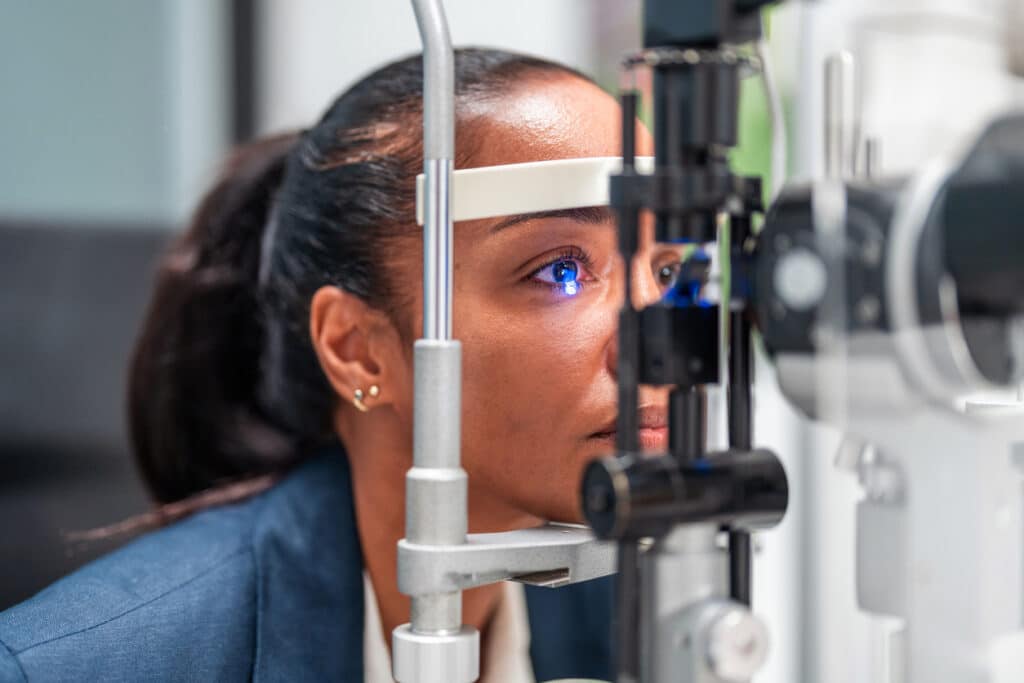
During a LASIK consultation, we measure your prescription, eye shape, corneal thickness, and eye dryness. Dr. Dornic reviews those findings before discussing which refractive procedures may be considered.
That evaluation is important because the question is not simply, “Which surgery is better?” A more useful question is, “Which procedure makes sense for my eyes?”
Your corneal structure and overall eye health can provide a much better answer than a side-by-side list of advantages.
Preparation and Recovery Are Different, Too
Some preparation instructions apply to both LASIK and PRK. Contact lenses can temporarily change corneal shape, for instance, so you may need to stop wearing them before your examination or treatment. Our LASIK and PRK preparation instructions include specific guidance based on the type of contacts you wear.
Recovery is where patients often notice a clearer difference. LASIK typically allows for quicker early visual recovery, while PRK requires time for the surface epithelium to heal. Follow-up care, medications, and activity instructions will depend on which procedure you undergo.
Compare LASIK and PRK Based on Your Eyes
Reading about LASIK and PRK can help you understand the basic differences, but your corneal measurements are what make the comparison personal. If you are considering refractive surgery in Cary, North Carolina, schedule a consultation with Laser Eye Center of Carolina or call 919-467-9955 to discuss your options with Dr. Dornic.