
Cloudy or hazy eyesight, glare, and increasing difficulty seeing at night can make familiar activities harder as cataracts progress. At Laser Eye Center of Carolina, Dr. Dean Dornic draws on his experience with cataract and intraocular lens procedures to help patients understand when cataract surgery may be worth considering. From our Cary, North Carolina office, we evaluate how changes in the natural lens are affecting both your eyesight and the activities that matter to you.
What Is a Cataract?
A cataract develops when the eye’s natural lens becomes cloudy. Normally, this lens helps focus light so you can see clearly. As clouding increases, less light reaches the retina properly and eyesight can become increasingly blurred or hazy.
Our guide to how your eye works explains the role of the natural lens and other structures involved in clear sight.
Cataracts commonly develop with age, although eye injuries, certain medical conditions, medications, and other factors can also contribute.
Common Cataract Symptoms
Cataracts usually change eyesight gradually rather than all at once. You may notice:
- Blurry or hazy eyesight
- Increased glare or sensitivity to bright lights
- Difficulty seeing at night
- Frequent changes in an eyeglass prescription
- Double vision in the affected eye
- Colors that appear less bright or vivid
Because cataracts tend to progress slowly, some changes may be easy to adapt to at first.
When Is Cataract Surgery Considered?
In the early stages, a new prescription, brighter lighting, or other adjustments may make everyday tasks easier. Surgery becomes worth discussing when cataracts interfere with activities such as reading, driving, working, or enjoying hobbies despite those measures.
You do not need to wait until a cataract reaches a particular age or vision number. The decision depends largely on how much the condition is affecting your daily life and what Dr. Dornic finds during your examination.
How Does Cataract Surgery Work?
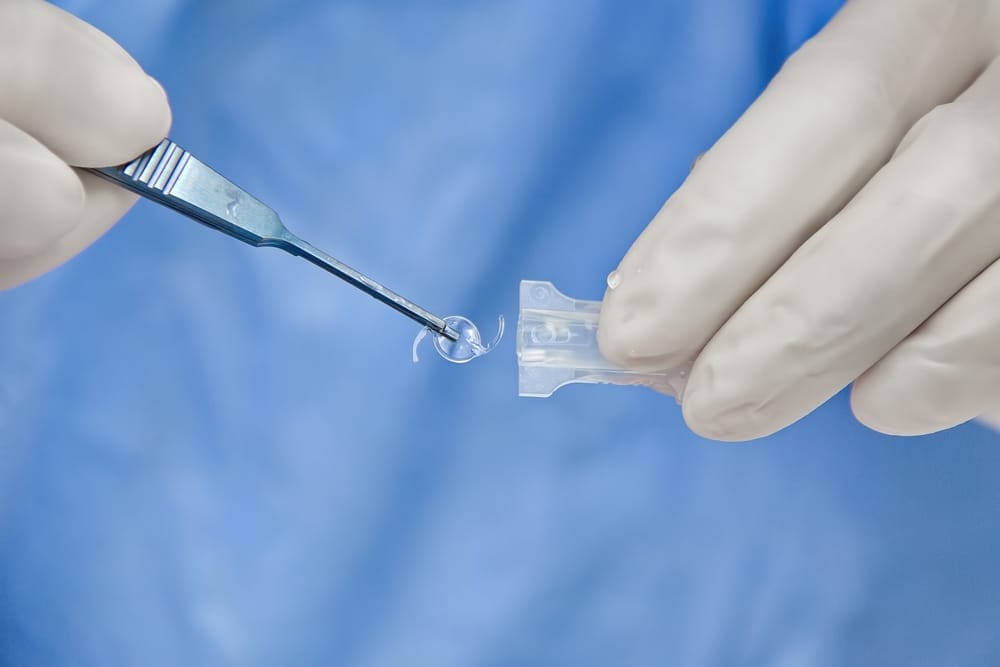
Cataract surgery removes the cloudy natural lens and replaces it with an artificial intraocular lens, or IOL.
During traditional cataract surgery, a small incision is created in the eye. Ultrasound energy is used to break the cloudy lens into smaller pieces so they can be gently removed. The IOL is then placed inside the eye to take over the focusing role of the natural lens.
Measurements taken before surgery help determine the power of the replacement lens. Your prescription, eye health, corneal measurements, and visual priorities all play a role in planning.
Vision may initially be blurry while the eye heals. How clearly you see at different distances afterward also depends in part on the IOL and your individual eye characteristics, and some patients continue to use glasses for certain tasks.
What Is Laser-Assisted Cataract Surgery?
Laser-assisted cataract surgery uses a femtosecond laser during selected portions of the procedure rather than relying entirely on handheld instruments.
The laser may be used to create certain incisions, open the lens capsule, or soften the cataract before it is removed. Dr. Dornic will review how surgery is being planned for your eye and whether a laser-assisted approach is part of that plan.
Using a laser does not remove the need for careful preoperative measurements, appropriate IOL selection, or postoperative follow-up. Those parts of cataract care remain important regardless of the surgical approach.
Who Is a Candidate for Cataract Surgery?
Cataract surgery may be appropriate when clouding of the natural lens is interfering with the quality or usefulness of your eyesight. Before recommending surgery, we examine your eyes and discuss which activities have become more difficult.
Surgical planning can also be influenced by:
- Your current prescription
- Corneal shape and astigmatism
- Other eye conditions
- Previous eye surgery
- Your priorities for near, intermediate, and distance vision
If you have previously undergone LASIK or another refractive procedure, let us know during your evaluation. Previous corneal surgery can affect the calculations used when selecting an IOL.
Why Choose Laser Eye Center of Carolina for Cataract Surgery in Cary?
Dr. Dornic is the founder and Medical Director of Laser Eye Center of Carolina. He is board-certified and fellowship-trained, with experience in cataract surgery, intraocular lens procedures, and several forms of refractive correction.
That background is especially useful when cataract surgery involves previous LASIK, astigmatism, or questions about how much dependence on glasses may remain afterward. Rather than approaching every patient with the same lens or surgical plan, we use your examination and visual priorities to guide the conversation.
Discuss Cataract Surgery in Cary, North Carolina
If cloudy or changing eyesight is beginning to interfere with everyday activities, an examination can help determine whether cataract surgery is appropriate now or whether continued monitoring makes more sense. Contact us at Laser Eye Center of Carolina or call (919) 467-9955 to arrange a cataract evaluation with Dr. Dornic in Cary, North Carolina.